Research
My research advances reconfigurable nanophotonics and optoelectronic systems through the design and characterization of nanoscale structures and functional materials. These include an ultracompact (< 25 µm²) circuit that electrically detects the spin state of incident photons by utilizing the optical spin-Hall effect [1], with on-chip detection capabilities [2]. This study demonstrates the high material integration density in nanophotonic circuits for optoelectronic applications – in contrast, current state-of-the-art methods rely on conventional bulk optics, such as retardation plates and free-space photodetectors in table-top setups to perform this task.
Additionally, I developed plasmonic waveguide-based electro-optic modulators on ferroelectric materials, achieving the most compact (30 μm2) and most efficient lithium niobate modulator to date (Fig. 1). This advancement holds significant promise, as low electro-optic efficiency and high RC time constants (which limit bandwidth) in current EO modulators are major performance bottlenecks in modern communication and data processing applications.
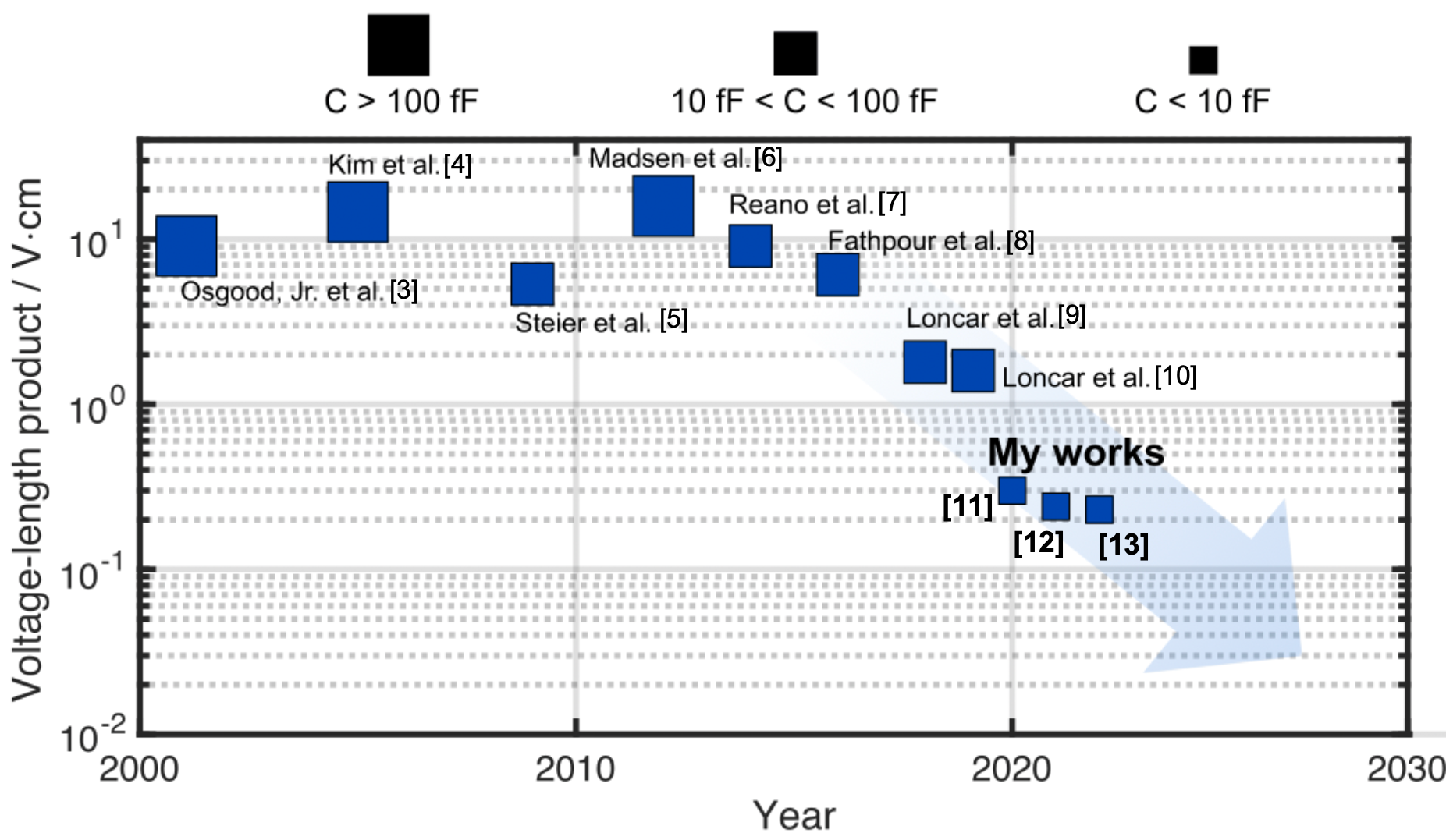
Fig. 1. Development of lithium niobate electro-optic modulators aimed at achieving higher efficiency, characterized by a lower voltage-length product (Vπ⋅L), where Vπ is the voltage required to induce a π phase shift in a device with an interaction length of L. Marker size reflects the capacitance C of each device. My works [11-13] achieved record-breaking EO efficiency and compactness (low capacitance).
[1] M. Thomaschewski et al., “Near-field observation of the photonic spin hall effect,” Nano Letters 23(24), 11447-11452 (2023).
[2] M. Thomaschewski et al., “On-chip detection of optical spin–orbit interactions in plasmonic nanocircuits,” Nano Letters 19(2), 1166-1171 (2019).
[3] R. M. Osgood Jr et al., “Electro-optic modulation in crystal-ion-sliced z-cut LiNbO3 thin films,” Applied Physics Letters 76(11), 1407-1409 (2000).
[4] H. S. Kim et al., “A novel, tapered, both in dimension and in index, velocity coupler switch,” IEEE Photonics Technology Letters 5(5), 557-560 (1993)
[5] W. H. Steier et al., “Lithium niobate ridge waveguides and modulators fabricated using smart guide,” Applied Physics Letters 86(16) (2005).
[6] C. K. Madsen et al., “Electro-Optically Tunable As2S3 Mach–Zehnder Interferometer on LiNbO3 Substrate,” IEEE Photonics Technology Letters 24(16), 1415-1417 (2012).
[7] R. M. Reano et al., “Hybrid silicon and lithium niobate electro-optical ring modulator,” Optica 1(2), 112-118 (2014).
[8] S. Fathpour et al., “High-performance and linear thin-film lithium niobate Mach–Zehnder modulators on silicon up to 50 GHz,” Optics Letters 41(24), 5700-5703 (2016).
[9] M. Lončar et al., “Nanophotonic lithium niobate electro-optic modulators,” Optics Express 26(2), 1547-1555 (2018).
[10] M. Lončar et al., “Ultra-low-loss integrated visible photonics using thin-film lithium niobate,” Optica 6(3), 380-384 (2019).
[11] M. Thomaschewski et al., “Plasmonic monolithic lithium niobate directional coupler switches,” Nature Communications 11(1), 748 (2020).
[12] M. Thomaschewski et al., “High-speed plasmonic electro-optic beam deflectors,” Nano Letters 21(9), 4051-4056 (2021).
[13] M. Thomaschewski et al. “Plasmonic lithium niobate Mach–Zehnder modulators,” Nano Letters 22 (16), 6471-6475 (2022).